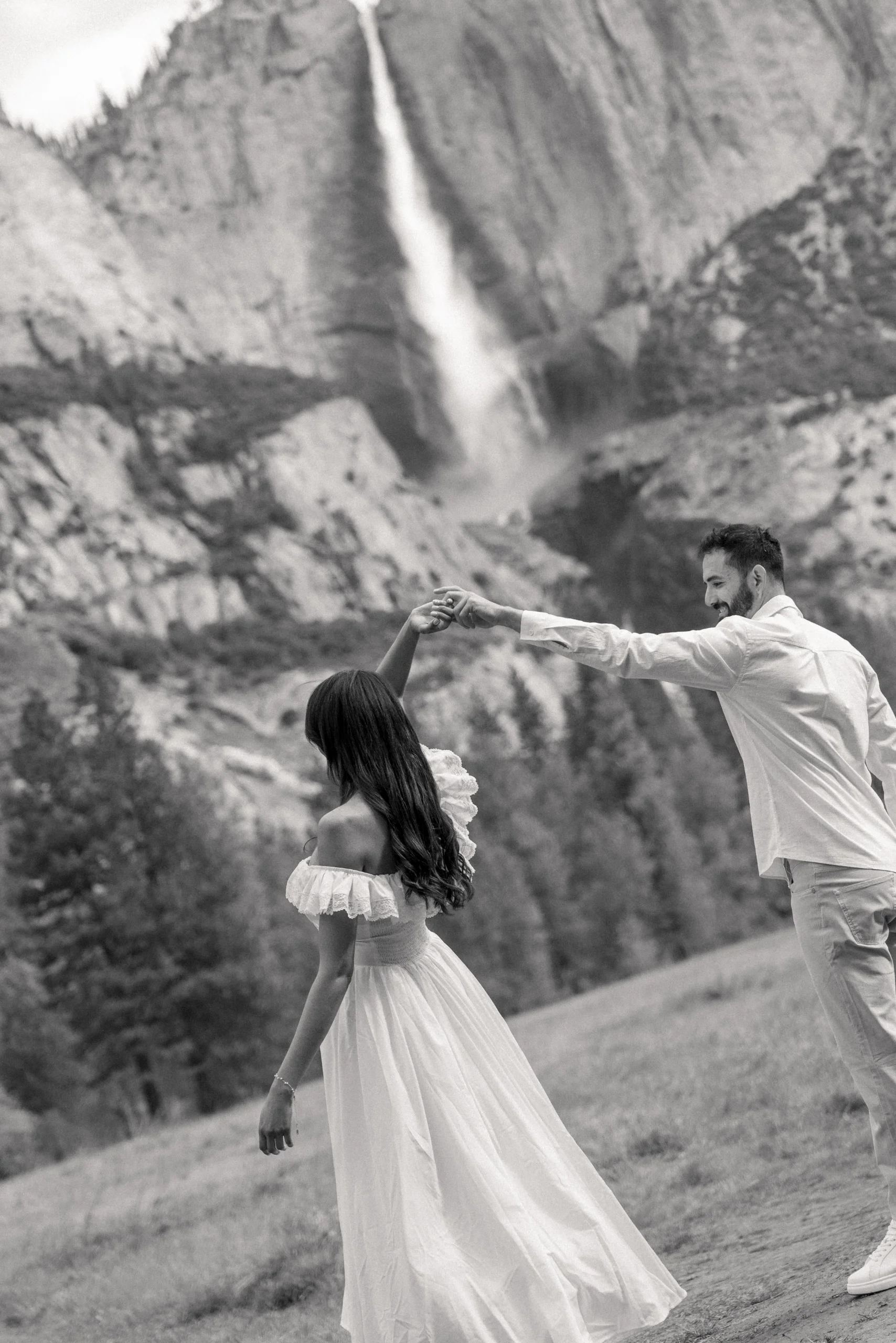
Yosemite is the rare place that looks bigger through a lens than it does in a memory. Half Dome, El Capitan, and the granite walls of the valley run to thousands of feet, and that scale is exactly what makes an elopement here read the way it does. A couple stands small against something very old, and the picture holds. If you are weighing a Yosemite elopement, most of the planning comes down to three things: where you are allowed to stand, the permit that lets you stand there, and the season that decides what the park is doing that week.
I photograph elopements as a quiet day built around two people, so what follows is practical rather than romantic. The romance takes care of itself once the logistics are settled.
Why the granite carries the frame
The valley floor sits at roughly four thousand feet, walled in by cliffs that rise most of a mile straight up. Because the walls are so tall and so close, the light does something you rarely get elsewhere. In the morning the sun clears the eastern rim late, so the valley holds a long, soft blue hour after the sky above is already bright. In the evening the last light climbs the granite instead of dropping below a horizon, and the top of El Capitan or Half Dome glows amber while the meadows below have gone cool. A photographer plans around that split. The couple can be in gentle shade while the mountain behind them is still lit.
Granite is also directional. It is pale and slightly warm, and on a clear afternoon it acts like a giant bounce card, throwing soft reflected light back onto whoever stands near it. That is part of why portraits at the base of the walls feel so flattering. The rock is doing half the work.
Named spots and what each one asks of you
Yosemite has a handful of settings that couples picture before they arrive. Each one carries a trade between the view and the effort or the crowd it takes to reach.
-
I.Tunnel View
The postcard: El Capitan on the left, Bridalveil Fall on the right, Half Dome centered down the valley. It sits right off Wawona Road, so it takes no hiking, which also means it stays busy from mid-morning on. It works best at first light or at the very end of the day, when the tour buses thin and the valley fills with warm side light. Good for a first look or vows with the whole valley behind you, less so for anything that needs quiet.
No hike, busy midday, best at dawn or dusk -
II.Glacier Point
More than three thousand feet above the valley floor, looking straight across at Half Dome and, in spring, the high waterfalls. The view is enormous. The catch is the road: Glacier Point Road is seasonal and typically opens only from late spring through fall once the snow clears. If you are picturing this one, your date has to line up with the road being open.
Seasonal road, huge view, drive-up access -
III.Taft Point
A walk of a bit over a mile from the Glacier Point Road brings you to an open granite edge with sweeping views and the exposed fissures Taft is known for. It rewards couples who want a small adventure and are steady near heights, and it photographs beautifully at sunset. It shares the same seasonal-road limit as Glacier Point, and there are no railings along most of the edge, so it is not the place for a nervous footing.
Short hike, exposed edge, sunset spot -
IV.Meadow and valley-floor sites
The valley meadows, the base of El Capitan, and the river bends near Cathedral Beach give you the granite walls as a backdrop without any elevation gain. These tend to be where ceremonies actually happen, because they are reachable, they spread crowds out, and the park designates specific spots for small weddings. Meadows are fragile, so you stay on established paths and boardwalks rather than walking out into the grass.
Easy access, common ceremony ground, stay on paths
The National Park Service permit
Here is the part couples most often get wrong. A wedding or a ceremony inside Yosemite is not a spontaneous thing. The National Park Service requires a special-use permit for weddings and elopements, and that permit is separate from your entrance reservation, your camping, and your marriage license. It exists so the park can protect the places people love and keep any one meadow from being trampled.
In general terms, the park designates certain locations for ceremonies, sets a cap on how many guests each one allows, and asks that you apply some weeks in advance rather than the day before. The specific approved sites, the group-size limits, the fee, and the lead time all change and are worth confirming at the source rather than trusting a blog. The reliable move is to read the current wedding-permit page on the National Park Service site, or call the park's permit office, and build your plan around what it says this season.
A few things tend to stay true across years. The permit governs the ceremony, not simply being photographed, so a couple exchanging vows needs one even for a party of two. It does not reserve the spot for you exclusively, since these are public places. And it does not replace your California marriage license, which is a county matter you handle before the day. For the license side and the wider legal picture, the guide to how to elope in California and the notes on California elopement permits walk through what applies statewide.
Season by season
Yosemite is really four different parks across the year, and the one you get depends entirely on your date.
Winter into February. Snow dusts the valley and the high roads close, but this is also the window for the natural firefall, when the late-February sun can light Horsetail Fall on El Capitan so it glows orange like flowing lava. It draws crowds and it depends on both water flow and a clear western sky, so it is a gamble rather than a guarantee.
Spring, roughly April into June. The best season for water. Snowmelt drives the falls to their peak, and Yosemite Falls, Bridalveil, and Vernal Fall run loud and full. The meadows green up, and the high country is still under snow, which keeps Glacier Point Road closed early in this window.
Summer. Warm, dry, and the most crowded stretch of the year on the valley floor. The upside is access: the high roads including Glacier Point and Tioga are open, the high country opens up, and long daylight gives you flexible timing. The waterfalls, though, thin out and some slow to a trickle by late summer.
Fall. Quieter than summer, with cooler air, turning oaks and dogwoods, and low water on the falls. A calm, uncrowded season for a valley-floor elopement, up until the seasonal roads close again for winter.
A park day that does not fight the shuttle or the sun
The valley runs on a free shuttle and a lot of one-way road, and in high season the parking fills early. That shapes the day more than people expect. The two things worth engineering around are the light and the crowds, and they happen to point the same direction: early and late.
A morning that starts before the day-trippers arrive gives you empty pullouts and that long valley-floor blue hour, then soft light as the sun finally clears the rim. An evening plan does the reverse, holding for the moment the granite lights up gold above cooling meadows. The flat, bright middle of the day is the hardest to photograph and the busiest to move through, so I usually treat it as rest, a meal, or the drive between an up-high spot and a valley one. If your date falls in the season when the park requires a day-use or entrance reservation, that goes on the checklist alongside the wedding permit, since the two are separate.
It also helps to keep the plan compact. Yosemite tempts couples into three viewpoints and a summit in one afternoon, and the driving eats the light. One up-high location and one valley-floor location, connected by a slow lunch, is usually a fuller day than a rushed loop of five.
Yosemite is a long way from being the only granite in Northern California. If the permit timing or the crowds give you pause, a Lake Tahoe elopement trades the valley walls for alpine water and a shorter drive from Sacramento, and the planning is gentler. Wherever you land, the shape of the day is what I help with: reading the season, timing the light, and keeping the logistics quiet enough that the two of you can forget them. What a day like this costs lives on the pricing page, and when you are ready to talk through a date, the inquire page is the place to start.